Paper Medium Focus

Fold, Cut, Compose

Paper responds to pressure and moisture with remarkable memory. Unlike stiff wood or pliable clay, paper has an innate grain direction that determines whether a fold will bend crisply or crack along the spine.

In this guide, we break down foundational techniques that elevate plain sheets into durable three-dimensional objects. Whether you are using heavy Italian Fabriano cotton watercolor scraps or Japanese washi fiber, understanding your stock transforms papercraft from guesswork into a satisfying tactile ritual.

Three Core Projects for Your Table

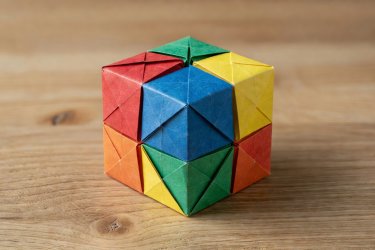
Completed geometric sonobe origami cube made from six folded colored paper units Geometry
Time: 40 Mins • 6 Square Sheets

1. The 6-Unit Sonobe Cube

The Sonobe unit, developed by Mitsunobu Sonobe, is the gateway to modular paper construction. By creating tabs and pockets along folded parallelogram faces, you build a rigid 3D cube requiring neither tape nor glue.

Key lesson: Consistent diagonal crease pressure and uniform valley folds.
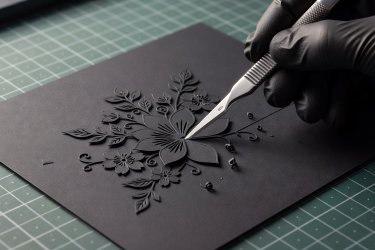
Precision craft scalpel blade cutting fine floral details into matte black card Precision
Time: 90 Mins • Swivel Knife

2. Botanical Scherenschnitte Silhouette

Rooted in 16th-century folk papercutting, this technique uses a sharp Swann-Morton No. 3 scalpel to cut continuous negative spaces. You will extract ivy and fern motifs from 120gsm matte silhouette paper.

Key lesson: Rotate the paper, never twist your wrist against the cutting angle.

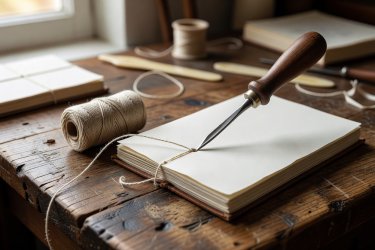
Bookbinding awl piercing signature pages with linen thread ready for coptic binding Book Arts
Time: 2.5 Hours • Waxed Flax Thread

3. Exposed-Spine Pamphlet Notebook

Bind fifteen folded sheets of drawing paper into a robust pocket sketch pad. Using a bookbinding awl and three-ply waxed linen cord, sew an authentic single-signature chain stitch through reclaimed cardboard covers.

Key lesson: Accurate hole punching along the spine fold using an awl guide.

Understanding Paper Weights & Grains

Choosing the wrong paper for a project is the single most common reason folds buckle or knife cuts tear. Refer to this practical workshop comparison:

Paper Category Typical Weight (GSM) Best Architectural Uses Workshop Advice
Origami / Kami 60 – 80 GSM Complex modular geometric folding Hold up to lamp light to check for grain uniformity.
Cartridge / Sketch 120 – 160 GSM Pamphlet book pages, Scherenschnitte Always score with a bone folder before attempting a 90-degree fold.
Cotton Rag / Washi 100 – 190 GSM Durable covers, visible stitching Long fibers prevent cracking when folded repeatedly across the grain.
Pulp Greyboard 300 – 600 GSM Hard book covers, structural bases Score multiple shallow passes with a safety utility knife; never force in one stroke.

Workspace Preparation & Tool Safety

Fresh Blades Save Fingers A dull scalpel blade skips over the surface and demands excessive downward pressure. Swap blades the moment resistance increases.
Find the Grain First Gently curve a test sheet between your fingers horizontally, then vertically. The direction that bows with minimal resistance is parallel to the grain.
Adhesive Restraint When pasting endpapers, apply neutral pH PVA glue thinly with a flat brush from the center outwards to eliminate buckling pockets.

Ready to combine your paper projects with textiles? Proceed to our Textile Hobbies Section.